


90L Industrial Ultrasonic Parts Washer | Large Ultrasonic Bath for Surgical & Medical Instruments
K1024 90L industrial ultrasonic parts washer for surgical & medical instruments, SUS304 stainless steel large ultrasonic bath, 1200W ultrasound, 4000W heater, single-phase 220-240V.
- Volume: 90 Litres
- Ultrasonic Power: 1200W (5-100% Variable Ultrasonic Power)
- Heating Power: 4000W
- Input Voltage: AC 220-240V, 50Hz (AC 110-120V, 60Hz to order)
- Frequency: 28KHz or 40KHz
- Internal Tank Size: 550 x 400 x 400 mm (Stainless Steel Tank)
- Overall Size: 770 x 620 x 620 mm
- Timer Settings: 1-9999 seconds or long-time running
- Heater: 20-95℃ adjustable
- Wooden case size: 87 x 73 x 82 cm
- Gross weight: 90 kg
WhatsApp: +8618681595853
Product Overview
The K1024 is the 90L industrial ultrasonic parts washer in the K series: a large ultrasonic bath for surgical and medical instruments, built on a 550 × 400 × 400 mm SUS304 ultrasonic cleaning tank with 1200W of ultrasonics and a 4000W heater, all on single-phase power. It is the size we build for two loads the smaller machines handle badly — instrument work that arrives in trays and cassettes from a hospital sterile services unit or a dental decontamination room, and industrial parts that are simply too long or too deep for 60 litres.
Three things change between the 60-litre ultrasonic cleaner and this one. The ultrasonic bath is 50 mm longer, 50 mm wider and 50 mm deeper, which is 27% more floor area and 340 mm of working depth instead of 290 — the difference between standing a vessel upright and laying it on its side. The heater is twice the power, 4000W against 2000W, which matters more than the volume does on a cold start. And the ultrasonic output rises from 900W to 1200W, which holds the same power density rather than lifting it.
One thing does not improve, and it is worth saying before anything else: at 5,200W combined, this ultrasonic washing machine draws about 23 A at 230 V, so it wants a 25 A circuit at minimum. If the building gives you one 16 A single-phase circuit, the 60-litre ultrasonic cleaner is the honest recommendation — this page will not talk you out of it.
What 90 Litres Ultrasonic Parts Washer Actually Holds
Litre ratings are the least useful number on a specification sheet, and on this model they are worse than usual. We sell it as the 90-litre machine; the tank measures 550 × 400 × 400 mm, which is 88 litres to the rim. Both numbers are true; neither one is what decides whether your load fits, and the number that actually runs the process is smaller again.
| Measurement | Figure | What it decides |
|---|---|---|
| Tank to the rim (geometric) | 550 × 400 × 400 mm = 88 litres | What a tape measure will tell you |
| Rated capacity | 90 litres | The model name and the catalogue figure |
| Working fill | ≈ 77 litres at 50 mm below the rim | What you heat, dose and change |
| Usable footprint inside the basket | ≈ 526 × 376 mm | Whether a tray or container goes in flat |
| Working depth above the basket floor | ≈ 340 mm | How tall a load can be |
| Basket clearance | ≈ 12 mm per side | Lost to the basket frame |
Nothing in that table is rounded up, and the differences are not academic. Sizing a heater, a detergent dose, or a change-out interval off “90 litres” overstates each of them by about 15%. A cycle runs on roughly 77.
The three-number test. Measure your largest item before anything else:
- Length — 520 mm inside the basket, 550 mm in the bare tank with the basket out
- Width — 370 mm inside the basket
- Height — about 330 mm of usable liquid above the basket floor (340 mm nominal, less a working margin)
If any of those three is exceeded, this is the wrong tank and no arrangement of the basket fixes it. The next size up is not a bigger version of the same thing — at 150 litres the ultrasonic bath goes to 600 × 500 × 500 mm and the heating moves to three-phase.
| Typical load | Fits? | Notes |
|---|---|---|
| Standard instrument container, 480 × 250 × 30 mm | 1 per cycle | A second one needs 500 mm of width — that is the 175L |
| Open instrument tray, 300 × 200 × 30 mm | 2 per cycle | 3 only if the load is mixed and one is turned |
| Small tray, 250 × 150 × 30 mm | 4 per cycle | The most efficient shape for this tank |
| Laparoscopic or orthopaedic instrument, 450 mm | Several, laid parallel | The 60L basket is 476 mm — this is where it runs out |
| Forceps and retractors, 400–520 mm | One layer, flat | Above 520 mm, go to the 150L |
| 5 L beaker or tall vessel, 300 mm | Stands upright | 340 mm of working depth |
| Valve cover, 420 × 180 × 90 mm | 1, flat | The 60L takes it too, with 50 mm to spare |
| Brake caliper, 250 × 180 × 120 mm | 4–6 per load | The best work this tank does at 28 kHz |
| Cylinder head, 4-cylinder, ≈ 430 mm | 1, lengthwise | An in-line six at ≈ 600 mm does not fit |
| Bare engine block, 480–520 mm | Length fits, weight does not | 60–90 kg needs a hoist and a different tank |
Depth is the number buyers under-check. A 350 mm tall vessel will not submerge in a 400 mm ultrasonic tank once the basket takes its 12 mm and 50 mm of headroom is left — it is a 330 mm vessel in practice. If your work is tall rather than long, the litre rating is not the constraint; the depth is.
Surgical Instrument Work: What It Does, and What It Does Not
90 litres is a recognised size in instrument reprocessing. European medical-device makers build 90-litre ultrasonic washers for CSSD and dental washing rooms, and the 88-litre / 550 × 400 mm format is sold across Asia for exactly that work. What varies between suppliers is not the hardware — it is what they are willing to promise. So here is the boundary, before the sales pitch.
What the industrial ultrasonic washer does. Cavitation removes blood, protein, saline residue, soft bone-cement residue, cutting fluid, and handling soil from instrument surfaces, box joints, ratchets, screw threads, serrations, matte and mirror finishes — without abrasion, and without the inconsistency of a brush. It reaches what a brush cannot: the inside of a box joint, the root of a serration, the thread of a cannulated screw.
What it does not do. It does not sterilise. It does not disinfect to a validated standard — that is a washer-disinfector’s job, tested to EN ISO 15883, and no ultrasonic bath replaces it. It does not remove endotoxin or prion protein. And it does not reliably clean the inside of a 2 mm lumen: cavitation does not travel round a bend in a channel, which is why lumened devices need flushing adapters or a dedicated irrigator. Dropping a laparoscopic instrument in a basket and hoping is the most common mistake in reprocessing, and no amount of ultrasonic power compensates for it.
Never start hot on blood. Protein coagulates above roughly 55–60°C and bonds to the surface once it does. A hot pre-soak makes a blood-soiled instrument harder to clean, not easier. Start at 40–45°C with an enzymatic detergent, clean, then rinse — and raise the temperature only for oil and grease loads, which are a different problem.
Open every hinge. A closed box joint is a shadowed cavity: cavitation cannot get in, and neither can detergent. Ratchets open, scissors apart, cannulae unassembled, and anything with a lumen flushed through before it goes in the basket.
Frequency, for instruments specifically. 40 kHz is the usual choice: finer bubbles, less surface erosion, kinder to matte finishes, laser marking, black coatings, and fine carbide edges. 28 kHz is for robust steel with heavy soil. On delicate ophthalmic and micro instruments, run reduced power and follow the device manufacturer’s reprocessing instructions — cavitation can erode a fine edge over repeated cycles, and no supplier should override a validated IFU.
Do not mix metals in one load. Stainless in contact with aluminium or carbon steel in a warm electrolyte makes a galvanic couple, and the aluminium loses. Anodised aluminium fixtures and plated parts go in a separate cycle, or not at all.
Instrument Trays, Cassettes and Containers
Instruments rarely arrive one at a time. They arrive as a set in a tray, a cassette, or a perforated container — and the number that fit is a plain arithmetic question about 526 × 376 mm.
One standard container per cycle. A 480 × 250 mm container fits lengthwise with room to spare; a second one would need 500 mm of width, which this tank does not have. If your workflow moves containers two at a time, the 175L (700 × 500 × 500 mm) or the 200L ultrasonic washing machine is the one you actually need, and buying 90 litres will only move the bottleneck.
Two open trays, or four small ones. A 300 × 200 mm open tray pairs with a second across the length; 250 × 150 mm trays go four to a load. That is the shape this tank is good at.
Loading rules that decide the result more than the power does.
- Leave 25 mm between trays and at least 30 mm between the load and the liquid surface. Cavitation shadows the middle of a packed basket.
- Never stack trays. Cavitation does not pass through a tray floor to the one beneath it.
- Keep everything off the tank floor and inside the basket — the floor is where the transducers are bonded, and a part resting on it blocks the energy going to its own underside.
- Load with the heaviest soil facing down. Debris falls away from the part instead of settling back onto it.
Where this ultrasonic bath stops. A department processing complete theatre sets all day does not need a bigger ultrasonic bath — it needs a washer-disinfector with a validated disinfection stage, and possibly a 200-litre ultrasonic unit ahead of it. We would rather say that at the quotation stage than after installation.
When the Load Is Industrial Rather Than Medical
The page URL says industrial ultrasonic parts washer, and it earns that name. The same 90 litres takes the component work that a 60-litre tank handles at its limit:
- Automotive component level — valve covers, timing covers, brake calipers, injector bodies, EGR valves, throttle bodies, DPF sections, small gearbox covers
- Hydraulic and pneumatic — cylinder barrels and rods up to about 520 mm, valve bodies, manifolds, fittings
- Machine shop — batch degreasing of machined castings, fasteners, brackets, mould inserts, parts with blind holes and cross-drilled galleries
- Restoration and small production — carburettor bodies, fuel pumps, instrument clusters, additive-manufactured parts with support residue
What it will not take is an assembly. A bare engine block is 480–520 mm long and 60–90 kg: the length fits, the weight does not, and there is no basket rating or lifting gear here for it. Cylinder heads over 520 mm, gearbox main cases, and long shafts go to the 150L (600 × 500 × 500) or the 500L with a hoist. The 100L model is the better answer for heavy degreasing in a wider tank; the 500L exists for blocks.
On baked carbon, be realistic. This industrial ultrasonic washer loosens combustion deposits and ring-groove lacquer at 60–70°C with an alkaline degreaser, given time. It does not strip them in one pass the way a 6000W tank does. If baked carbon is the daily workload rather than an occasional job, the bigger machines are the honest recommendation.
1200W Across 90 Litres: Density, Frequency and Control
1200W in 90 litres is about 13 W per litre — the same density band as the rest of the range, not a step up.
| Model | Ultrasonic power | Rated volume | W per litre |
|---|---|---|---|
| K1018 60L | 900 W | 60 L | 15.0 |
| K1024 90L | 1,200 W | 90 L | 13.3 |
| K1030 100L | 1,500 W | 100 L | 15.0 |
| K1120 500L | 6,000 W | 500 L | 12.0 |
That number is what to compare when a competitor quotes “1200W high power” for the same 90 litres: it is not high power; it is normal power, and any page that calls it high is selling by adjective. What is genuinely above the class average on this machine is the heater — 4000W where most 90-litre builds use 3000W — and the separate generator.
Output runs from 5% to 100%. The low end is not decoration: it is what lets one tank take a 40 kHz instrument load at 60% power and a 28 kHz cast-iron component load at full output. A fixed-output machine cannot make that adjustment, and no operator technique replaces it.
Automatic sweep frequency shifts the output across a band around the set frequency so standing waves do not park in the same places cycle after cycle. On a 550 mm tank, the effect is visible on a foil test: without sweep, the foil shows bands of damage next to bands of nothing.
28 kHz or 40 kHz is fixed at order. 28 kHz gives larger, more aggressive bubbles for robust metal and heavy soil. 40 kHz gives finer cavitation for instruments, aluminium, precision parts, and any load where surface finish matters. You cannot switch later — if you genuinely need both, that is the dual-frequency range, not this machine.
4000W Heater: Twice the Power of the Machine Below It
The heater is the least discussed and most consequential difference between this machine and the 60-litre. 4000W warms 77 litres at the same rate the 60-litre’s 2000W warms 52 — the same minutes per litre, but 25 more litres per cycle:
| From 20°C to | Energy into the bath | At 4 kW | Realistic, with losses |
|---|---|---|---|
| 40°C | 6,446 kJ | 27 min | ≈ 30 min |
| 50°C | 9,669 kJ | 40 min | ≈ 45 min |
| 60°C | 12,893 kJ | 54 min | ≈ 60 min |
| 80°C | 19,339 kJ | 81 min | ≈ 90 min |
The heater is for holding temperature, not for fast heat-up between loads. Leave the bath at working temperature through the shift, and the cost is paid once, not once per tray.
The thermostat runs to 100°C; you will seldom use the top of it. Cavitation weakens above roughly 80°C — as the solution nears boiling, vapour fills the bubbles, and they collapse less violently. A hotter bath is not a faster clean, and it costs evaporation, fume, and detergent life.
Working temperatures: 40–45°C for enzymatic chemistry on blood and protein (hotter denatures the enzyme and can fix the soil); 55–65°C for oils, grease and cutting fluid; 60–70°C for carbon film with an alkaline degreaser. If your process involves solvents, tell us before ordering — solvent work changes the heater arrangement and the lid, and must never run above the solvent’s flash point.
Single-Phase Power: 5,200 W is about 23 A
This is the section most buyers should read first, because it decides whether the machine can be installed at all.
| Supply | Combined draw | Current | Circuit needed |
|---|---|---|---|
| 220 V, 50 Hz | ≈ 5,200 W | ≈ 23.6 A | 25 A minimum, 32 A preferred |
| 230 V, 50 Hz | ≈ 5,200 W | ≈ 22.6 A | 25 A minimum, 32 A preferred |
| 240 V, 50 Hz | ≈ 5,200 W | ≈ 21.7 A | 25 A minimum, 32 A preferred |
| 110–120 V, 60 Hz (to order) | ≈ 5,200 W | ≈ 43–47 A | Not a practical 120 V load — talk to us first |
No three-phase needed, but this is not a 16 A machine. The heater alone is 4000W, about 17.4 A at 230 V; add the ultrasonics, and you are at 23 A. A standard 16 A single-phase circuit will trip the moment both come on together, which is exactly when the machine is doing its job.
This is the top of the “ordinary socket” ladder. From 90 litres upward, plan the supply before you plan the floor space: give the machine its own circuit, do not share it with a welder, compressor or hoist, and allow headroom for inrush. On a 32 A circuit, the machine runs with margin, and the socket stays cool.
If you are on 110–120 V, tell us before ordering. The full 5,200W is not a 120 V load in any normal building; the heater and generator are specified to suit the supply you actually have, and that conversation needs to happen before the order, not after.
The Separate Generator, and Why it Matters Here
Most 90-litre ultrasonic parts washers in this class bolt the generator to the tank or tuck the board under the lid, inches from 77 litres of hot detergent. The K1024 puts the drive electronics in their own enclosure, and that changes three things.
The electronics run cooler and drier. The usual failure on integrated units is not a dead transducer — it is a corroded board. Keeping the drive section out of the splash and vapour zone is the cheapest reliability gain available at this price.
Service does not require draining the bath. A generator can be swapped or sent for repair while the tank stays full and in place. On a machine running several cycles a day, that is the difference between an hour and a lost shift.
The tank has fewer things to go wrong inside it. No control board sitting above warm chemistry.
What it does not buy you is redundancy. One generator feeds one transducer bank: if it fails, cleaning stops. Redundant, individually serviceable cabinets start at the 240-litre and 500-litre builds.
SUS304 Ultrasonic Bath, Basket and Drain
The ultrasonic bath is SUS304 stainless steel, formed, welded and finished so the interior does not key soil into the surface. 304 handles alkaline, neutral, and mild acidic aqueous chemistry, plus the enzymatic detergents used on instruments — the normal working range for both audiences on this page.
What 304 does not handle is chloride. Hypochlorite, ferric chloride, and hydrochloric acid blends will pit it, and instrument reprocessing is exactly where chlorine bleach turns up. If your procedure uses any of those, say so before ordering rather than after the first leak.
Basket, drain and lid. The stainless mesh basket lifts parts clear of the tank floor for full cavitation access, and it sets your working depth — which is why the usable depth in the table above is measured from the basket, not from the tank floor. A front drain valve empties the bath by gravity into a floor drain or a collection drum, without tipping 77 litres of warm chemistry by hand. The lid cuts noise and evaporation and holds temperature between loads; on a machine that stays hot all shift, it pays for itself in detergent alone.
Four castors let one operator move the machine to the drain point rather than carrying solution to it.
Where the 90L Ultrasonic Parts Washer Sits in the K Range
| Model | Tank (mm) | Volume | Ultrasonic | Heater | Supply | The job it is built for |
|---|---|---|---|---|---|---|
| K1018 60L | 500 × 350 × 350 | 60 L | 900 W | 2000 W | 16 A single-phase | Lab glassware, 2 instrument trays, workshop components |
| K1024 90L | 550 × 400 × 400 | 90 L | 1,200 W | 4,000 W | 25 A single-phase | Instrument sets and trays, long parts up to 520 mm |
| K1030 100L | 600 × 450 × 400 | 100 L | 1,500 W | 4,000 W | 25 A single-phase | Heavier degreasing, wider load |
| K1036 150L | 600 × 500 × 500 | 150 L | 1,800 W | 6,000 W | Three-phase | Cylinder heads, gearbox cases |
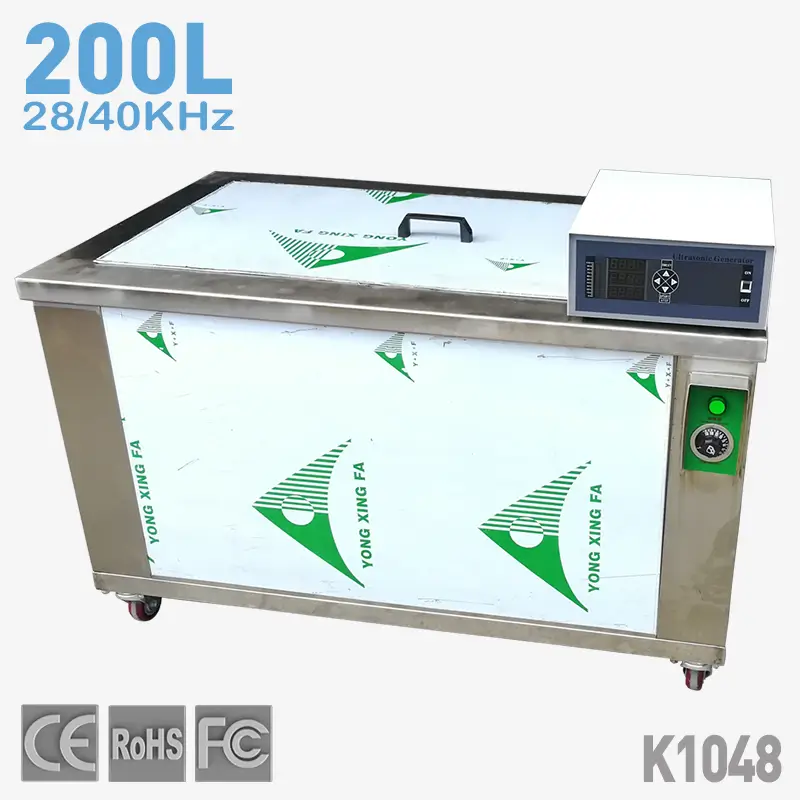
| K1048 200L | 800 × 500 × 500 | 200 L | 2,400 W | 6,000 W | Three-phase | Production batches, two containers |
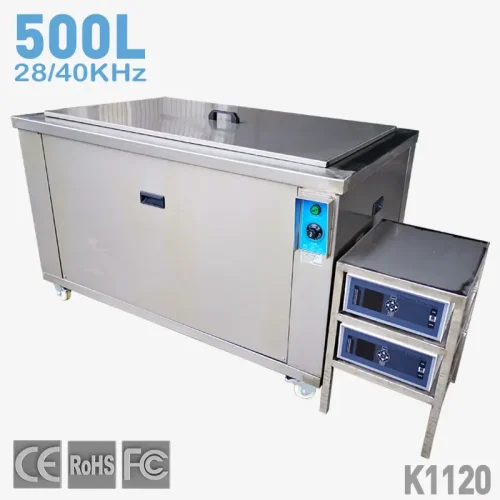
| K1120 500L | 1200 × 700 × 600 | 500 L | 6,000 W | 12,000 W | Three-phase | Engine blocks, large assemblies |
The step that matters. Between 60 L and 90 L, the gain is 50 mm in each direction and twice the heater — that is part size and heat-up, not tray count. Between 90 L and 100 L, the gain is 50 mm of width. Between 100 L and 150 L, the gain is power, depth and a three-phase heater. If your constraint is trays, the jump you want is 150 L or 175 L; if it is part length, 90 L is the first rung that clears 480 mm.
Full internal dimensions for every volume from 60L to 3110L are on the industrial ultrasonic parts cleaner series page, and the K series specification table lists every model side by side. Custom tanks on this platform have been built up to 6000 litres.
K1024 90L Ultrasonic Washer Specifications & Parameters
| Parameter | Specification |
|---|---|
| Model | K1024 |
| Volume | 90 Liters |
| Ultrasonic Power | 1200W (5-100% variable power) |
| Frequency | 28KHz or 40KHz |
| Heating Power | 4000W (AC220-240V, 50Hz) |
| Internal Tank Size | 550 x 400 x 400 mm (SUS304 stainless steel) |
| Overall Size | 770 x 620 x 620 mm |
| Timer Settings | 1-9999 seconds or as long as 24 hours running |
| Heater Setting | 20-95℃ adjustable |
| Sonic Input Voltage | AC220-240V, 50Hz |
| Accessories | Stainless steel cleaning basket; Drainage; Lid; Power lines |
| Features | 5-100% power-adjustable; Automatic sweep frequency function; |
What’s Included
- K1024 90L ultrasonic cleaning tank with lid
- Separate ultrasonic generator cabinet
- Stainless steel mesh cleaning basket
- Power cable
- Packed in a wooden case, 870 × 730 × 820 mm, gross weight 90 kg
More Industrial Ultrasonic Parts Washer Specifications & Parameters
K Series Specifications Sheet
There are various volumes and tank sizes for the industrial ultrasonic parts washers. So that you can choose the most appropriate parts washer tank for your cleaning work. Check the ultrasonic tank specifications below. If they are not the specifications you need, don’t worry! Please provide detailed requirements, we are able to custom-make it for you!

More Available Volumes




90 Liter Ultrasonic Washer Details Showing


FAQ
Does the K1024 industrial ultrasonic parts washer need three-phase power?
No. It runs on single-phase 220–240V, but it draws about 5,200W with the ultrasonics and the 4000W heater running together, which is roughly 23 A at 230 V. That means a 25 A circuit at minimum, and 32 A is better. A standard 16 A circuit will trip when both come on — if that is all you have, the 60-litre model is the honest answer.
Is it 88 litres or 90 litres?
Both. The ultrasonic bath measures 550 × 400 × 400 mm, which is 88 litres to the rim — that is the figure on our factory sheet and what a tape measure will tell you. We sell it as the 90-litre model. The number that actually runs your process is smaller again: about 77 litres at a normal working level 50 mm below the rim. Heat, detergent dose, and change-out cost should be sized on 77.
Is this a steriliser? Does it disinfect instruments?
No. It is a cleaning step. Cavitation and detergent remove soil, biofilm, and residues, and the instruments then go to a washer-disinfector or an autoclave. This machine does not sterilise, does not disinfect to a validated standard such as EN ISO 15883, and does not remove endotoxin. Lumened devices also need flushing adapters — cavitation does not reliably reach inside a 2 mm channel.
28 kHz or 40 kHz for surgical instruments?
40 kHz for almost all instrument work: finer cavitation, less erosion of matte finishes, laser marking, and carbide edges. 28 kHz for robust steel with heavy soil, or for industrial components. The frequency is fixed at order and cannot be switched later; if you need both, that is the dual-frequency range.
Can it run 24 hours a day?
Yes. The separate generator and industrial transducers are built for continuous duty, and the timer runs to 9999 seconds or continuously. Monitor solution concentration and level, change chemistry when it turns cloudy, and keep the lid on to limit evaporation.
Can the tank be built to a different size?
The ultrasonic bath size on this platform is built to order, and custom builds have gone up to 6000 litres. But if your load routinely exceeds 520 mm, a bigger standard tank is usually cheaper and faster than a custom 90 — and you keep the single-phase supply. Send the part or instrument dimensions, and we will say which way is worth doing.
Related products
-

90L Auto Lift Industrial Ultrasonic Cleaner | Automatic Lifting System Ultrasonic Bath for Laboratory
KAL1024 90L auto-lift industrial ultrasonic cleaner: 1200W power, 40KHz, 3000W heat, pneumatic basket lift. For laboratory & precision parts cleaning.…
-
300L Industrial Ultrasonic Cleaning Tank | Custom Large Ultrasonic Bath for Parts Degreasing
K1072 300L industrial ultrasonic cleaning tank, 1000 x 600 x 500 mm large ultrasonic bath. Two independent generators, 3600W ultrasound,…
-
500L Big Ultrasonic Cleaner | Custom Large Industrial Degreasing Tank for Engine Blocks
500L big ultrasonic cleaner for engine blocks with a 1200 x 700 x 600 mm large industrial degreasing tank. 6000W…
-
Custom Ultrasonic Anilox Roller Cleaner for Ceramic and Stainless Steel Printing Rollers
Custom ultrasonic anilox roller cleaner for ceramic and stainless steel printing rollers, with rotating shaft design, adjustable roller position, and…



Any questions refer to this item? Just let us know!
Reviews
There are no reviews yet.