

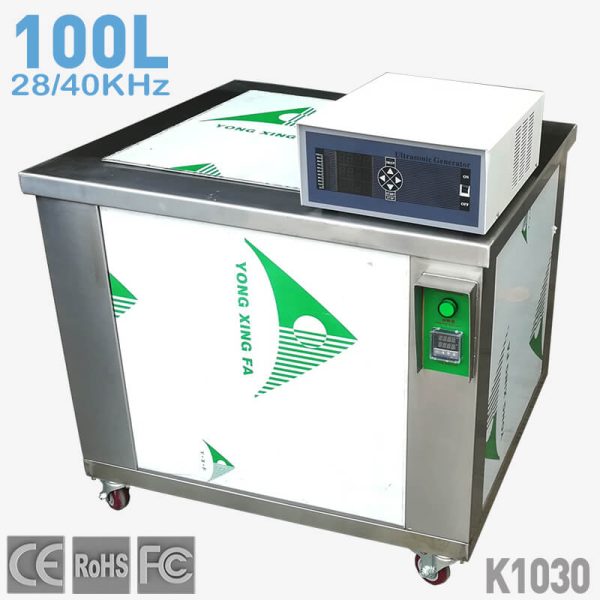


100L Industrial Ultrasonic Cleaner | Heavy-Duty Parts Washer for Auto & Engine Components
K1030 100L industrial ultrasonic cleaner for cylinder heads, with 4000W heating. Heavy-duty parts washer built for auto parts and engine component degreasing.
- Volume: 100 Liters
- Ultrasonic Power: 1500W (5-100% Adjustable Ultrasonic Power)
- Heating Power: 4000W
- Voltage: AC 220-240V, 50Hz (AC110-120V, 60Hz to order)
- Frequency: 40KHz or 28KHz
- Internal Tank Size: 600 x 450 x 400 mm (Stainless Steel Tank)
- Timer Settings: 1-9999 seconds or long-time running
- Heater: 20-95℃ adjustable
- Accessories: independent generator, cleaning basket, lid, power line
- Package Size: 92 x 78 x 82 cm
- Gross Weight: 110 KG
WhatsApp: +8618681595853
100L Industrial Ultrasonic Cleaner: Overview
The K1030 is a 100L industrial ultrasonic cleaner built as a heavy-duty industrial parts washer for auto and engine components. The ultrasonic bath size is 600 × 450 × 400 mm in SUS304 — wide enough for a cylinder head up to 580 mm, a transmission case, or a full basket of machined castings in a single load, with 1500W of ultrasonics and an electric heater as standard.
The reason to be on this page is floor area, not depth. 600 × 450 mm takes a small-block cylinder head, a transmission case, a pair of pump housings, or a basket of machined castings in one load. Depth is 400 mm — the same as on our 90L industrial ultrasonic parts washer — so anything that will not stand upright in a 90-litre ultrasonic bath will not stand upright in this one either. Buy width here; if you need height instead, step up to the 150L industrial ultrasonic parts cleaner.
Two figures are worth having before the specification table: the ultrasonic bath holds 108 litres to the rim and about 94.5 litres at working level, so “100 litres” is a model number rather than a volume you will ever heat. One size up in the same family is the 120L integrated industrial ultrasonic cleaner, which adds 50 mm of width on the same 400 mm depth.

A Heavy-Duty Parts Washer for Auto and Engine Components
“Heavy-duty” here is not a claim about cleaning force. It describes what the industrial ultrasonic cleaner is built to survive: transducers rated for continuous production shifts rather than an hour at a time, drive electronics in their own cabinet away from 60 °C bath heat and chemical vapour, an ultrasonic tank formed in one piece with the rim flanged over the body, and a ball valve drain that lets one person empty 94.5 litres without lifting anything.
The loads this size is bought for are consistent: cylinder heads from four- and six-cylinder passenger and light commercial engines, manual and automatic transmission cases, valve bodies and hydraulic manifolds, turbocharger housings, brake calipers and brackets, and baskets of small machined castings that arrive with cutting fluid still in the galleries.
Who Should Buy the 100L Industrial Ultrasonic Cleaner — and Who Should Not
Buy this size if your parts are wide — up to roughly 580 mm long and 426 mm across inside the basket — if you clean in batches rather than one at a time, and if you have a 25 A single-phase circuit or will order the heater at a rating your circuit can carry.
Do not buy it if your parts are tall: 340 mm of working depth above the basket is the limit, and this machine adds no height over the 90-litre. Do not buy it for a single 700 mm inline-six head; the 150-litre is also 600 mm long, so that job belongs on the 200-litre. And do not buy it expecting a derusting or paint-stripping machine — it is neither.
How Big Is a 100 Litre Ultrasonic Cleaning Tank?
Every figure below is calculated from the cleaning tank, not from the model name.
| Measurement | Value | How it is derived |
|---|---|---|
| Tank to the rim | 108 L | 600 × 450 × 400 mm |
| Working bath | ≈94.5 L | 600 × 450 × 350 mm — filled 50 mm below the rim |
| Internal basket | ≈576 × 426 mm | allowing 12 mm on each side for the basket wall |
| Working depth above the basket | ≈340 mm | 350 mm of water less the basket sitting height |
Dose the detergent on 94.5 litres, not on 100. At 5% by volume, that is about 4.7 kg of powder per fresh fill. Getting it 6% wrong sounds trivial and is not: an over-strength alkaline bath leaves a residue film on castings that dries as a visible haze, and an under-strength one stops lifting carbonised oil and starts redistributing it.

The same 94.5 litres governs what an ultrasonic bath change costs in detergent and electricity, and how long the next heat-up takes. Treat it as the real capacity of the machine and every other number on this page agrees with it.
Basket Size and Usable Working Depth
The basket is about 576 × 426 mm internally, and that is what actually limits part size — not the 600 × 450 mm tank. The basket wall and its sitting height eat into both the floor and the depth. Parts much over 520 mm start to foul the basket ends once they are loaded at an angle; parts standing more than 340 mm tall will not clear the waterline with the basket in place.
108 Litres to the Rim, 94.5 Litres at Working Level
You can lift the basket out and work in the bare tank, which recovers the full 350 mm of water depth and the full 600 × 450 mm floor. What you lose is the ability to lift a whole batch out at once, which is why most buyers keep the basket in.
What Fits in a 100L Ultrasonic Cleaner
This is the section most suppliers leave out, so the boundary comes first.
Cylinder Heads up to 580 mm Long
A small-block V8 head is typically 508–560 mm long. In a 576 mm block, a 550 mm head sits with about 13 mm at each end — enough, but not generous, and heads vary more than the nominal engine size suggests. Measure the casting before ordering: a nominal “small block” can be 508 mm on one generation and 560 mm on another.
Above roughly 580 mm, the answer is not the 150-litre. That model is also 600 mm long, so it buys depth and width but no extra length. Step to the 200-litre at 800 mm for a single longer head; two heads side by side need the 500L at 1,200 mm.
Transmission Cases, Valve Bodies and Castings
Transmission cases, valve bodies, hydraulic manifolds, pump housings, brake calipers, turbocharger housings and machined brackets all sit comfortably inside 576 × 426 mm, usually several at a time. A case taller than 340 mm goes in on its side, which is how most shops load them anyway — the oil galleries then drain as they clean instead of trapping air.
A basket of small castings is where the floor area pays for itself: 600 × 450 mm holds a full layer with 20–30 mm between parts, which is the spacing cavitation needs to reach the faces that matter.
What Does Not Fit — and Which Tank Size Does
Three loads defeat this machine, and it is cheaper to know now:
- Inline six heads, at about 700 mm. Go to the 200L (800 mm) or the 300L.
- Two cylinder heads at once, which need about 1,100 mm. The 500L at 1,200 mm is the first model that takes them side by side — the 300L at 1,000 mm does not.
- Two 300 × 200 mm trays side by side, which need 600 mm against the 576 mm available. Two 280 mm pans will fit; 300 mm pans will not.
An engine block is a borderline case: a four-cylinder block at 400–450 mm long and 350–400 mm tall will not stand upright in 340 mm of working depth, so it goes in on its side or in the bare tank. A block also weighs 80–120 kg — tell us the weight, and we will confirm what the basket will take, because we do not publish a basket rating we have not tested.
How Ultrasonic Cavitation Cleans Engine Components
Ultrasonic cleaning does not scrub. The generator drives the transducers bonded to the underside of the ultrasonic tank, and the tank floor vibrates at 28 or 40 kHz. That pressure wave tears the water apart into millions of microscopic bubbles, which collapse against the surface of the part. Each collapse produces a local jet that lifts soil out of geometry a brush cannot reach: blind holes, thread roots, oil galleries, the serrations on a shaft, the gap between a valve and its seat.
Transducers, Power Density and 15.9 W per Litre
The K1030 runs 1500W across 94.5 litres of working bath — 15.9 W per litre. The 90-litre runs 1200W across 77 litres at 15.6 W per litre. Read those two together: the power density is essentially unchanged. The extra 300W is there to hold the same cavitation energy over a larger floor, not to clean harder per square millimetre.
| Model | Ultrasonic | Working bath | W per litre |
|---|---|---|---|
| 60L | 900 W | 52 L | 17.3 |
| 90L | 1,200 W | 77 L | 15.6 |
| 100L | 1,500 W | 94.5 L | 15.9 |
| 120L | 1,500 W | 105 L | 14.3 |
So what the money buys is about 23% more floor area per cycle at the same cleaning intensity — a throughput gain, not a power gain. Twice the parts, not twice as fast per part. If a casting is not coming clean at 1500W, more watts is the wrong answer; the answers are 28 kHz instead of 40, a hotter bath, a longer cycle, or a better detergent.
Sweep Frequency and Even Cleaning Across a 600 mm Tank
A fixed frequency settles into standing waves: some patches of the tank cavitate hard, others barely at all. In a small tank, you can move parts around and not notice. In a 600 mm tank, the dead zones are large enough to leave a load half-cleaned and half-untouched.
Sweep frequency runs automatically whenever the ultrasonics are on. It shifts the drive across a narrow band around the centre frequency several times a second, so the pressure nodes move and no part of the tank stays quiet. For anyone loading the full footprint rather than one part in the middle, this is the most useful feature on the machine.
28 kHz vs 40 kHz: Ultrasonic Frequency for Auto Parts
One frequency is specified at order, and the generator runs it with a sweep frequency. The choice changes the character of the cavitation, not the amount of power.
28 kHz for Cast Iron, Carbon and Heavy Grease
Lower frequency means fewer, larger bubbles and a more violent collapse. 28 kHz is the choice for cast iron, steel, thick carbon films on combustion surfaces, heat-exchanger scale, rust-adjacent deposits, and heavy grease on rough castings. It is also harder on machined finishes and thin sections, which is why it is not the default for everything.
40 kHz for Aluminium, Plated and Precision Parts
40 kHz produces a denser field of smaller bubbles: gentler per collapse, better distributed, and safer on aluminium, plated surfaces, precision machined faces, valve bodies with fine spools, and anything where surface finish matters more than speed. For a shop with mixed loads, 40 kHz is the safer single choice.
When Dual Frequency Is the Better Answer
If you alternate castings with aluminium, or clean carbonised steel one day and plated parts the next, a dual-frequency ultrasonic cleaner beats compromising on one frequency. We build those on the same platform; the trade-off is cost, and one more setting to get right at the start of a cycle.
Ultrasonic Degreaser, Bath Temperature and Bath Life
The machine removes soil mechanically; the chemistry does the dissolving. For engine and transmission work, that means an aqueous alkaline degreaser with a wetting agent, typically 3–5% by volume.
Alkaline Degreaser Concentration for Automotive Soils
Run 55–65 °C for grease and carbonised oil, and 45–55 °C where a coating, a soft metal or a precision finish limits the temperature. Below about 40 °C, an alkaline degreaser works slowly enough that buyers blame the machine; above 70 °C, you accelerate evaporation, attack aluminium and shorten heater life for no gain in cleaning.
Dose on 94.5 litres, and check concentration weekly rather than topping up by eye. Drag-out on parts removes detergent steadily, and a bath that is at 2% instead of 5% cleans like a cold bath no matter what the display says.
What Not to Put in an Ultrasonic Cleaning Bath
- No chlorinated solvents. They attack stainless at weld lines and stress the heater sheath, and they are a fume problem in an open tank.
- No acids on aluminium. Alkaline attack on aluminium is the faster failure; acid attack on stainless is the slower one. Both end with a new tank.
- No sealed cavities or blind galleries full of solvent. They contaminate the bath and, in the worst case, pressurise as they heat.
Rinse after cleaning — a short dip in clean water at 50–60 °C, then dry — or the detergent residue dries as a haze on machined surfaces and gets blamed on the machine.
Ultrasonic Cleaning Cycle Times for Auto Parts
The figures below are starting points for a bath already at temperature with fresh detergent. They are not guarantees; test on one scrap part before committing a production batch.
| Soil | Frequency | Bath temperature | Typical cycle |
|---|---|---|---|
| Dust, coolant film, light handling oil | 40 kHz | 45–50 °C | 3–6 min |
| General workshop grease, machining oil | 40 kHz | 55–60 °C | 10–20 min |
| Carbonised oil film on cast iron | 28 kHz | 60–65 °C | 30–45 min |
| Dried cutting fluid in machined galleries | 28 kHz | 55–60 °C | 20–30 min |
| Polishing compound in recesses | 40 kHz | 50–55 °C | 8–15 min |
Loading Rules That Matter More Than Cycle Time
Four things change results more than adding ten minutes does:
- Do not stack parts. Cavitation is line-of-sight in practice. Two castings clamped together shield each other, and the mating faces stay dirty.
- Turn blind holes and galleries so air can escape. A downward-facing blind hole holds an air pocket, and an air pocket is a no-clean zone.
- Pre-soak heavy grease. Five minutes in the same detergent at 40 °C will halve the ultrasonic time on a grease-packed housing.
- Skim the oil before every cycle. A bath carrying a floating oil layer puts that oil back on the next load, and that is the most common reason a machine “stops working”.
Heat-Up Time for a 100L Ultrasonic Cleaner
The heater is 4000W, the same as the 90-litre, and the bath is 22.7% larger. That is the whole of this section.
Why the 100L Heats More Slowly Than the 90L
| 90L (77 L bath) | 100L (94.5 L bath) | |
|---|---|---|
| Heater | 4000 W | 4000 W |
| 20 → 60 °C, at 100% efficiency | 54 min | 66 min |
| Realistic, with tank mass and losses | ≈60 min | ≈70–75 min |
Heat up once at the start of a shift, and twelve extra minutes is nothing. Dump and refill three times a day, and it is 36 minutes every day. Fill with water at 40–50 °C, keep the lid on between loads, and do not change the bath until the detergent is spent — those three habits close most of the gap.
Power Supply: Heater and Transducer Load
Ultrasonics plus the standard heater is 5,500W, about 24 A at 230 V, so plan a 25 A single-phase circuit, 32 A preferred. The rating is a build choice rather than a fixed feature: on a smaller supply, the heater is specified lower, and the only cost is a longer heat-up. Send the voltage and the breaker rating, and the heater is built to fit it. The tank, the ultrasonics, and the footprint do not change.
Heavy-Duty Parts Washer vs Solvent Sink, Spray Washer and Subcontracting
A 100-litre ultrasonic tank is usually bought to replace one of three things, and it does a better job than two of them.
Better than a manual solvent sink. No solvent purchase, no solvent disposal, and no brush work in box joints, threads, and serrations. Slower per square metre of flat surface, much faster everywhere a brush cannot reach. The caveat is real: you must heat the bath and keep the chemistry right. A cold, tired ultrasonic bath is worse than a brush.
Different from a spray or immersion washer, not better. A spray washer wins on high-volume chip removal and on flushing large bores quickly. Cavitation wins on blind holes, crevices, thread roots, stacked small parts, and any geometry that defeats a jet. Shops running both usually put the spray washer first for chip removal and the ultrasonic last, before assembly.
Better than sending parts out. You control turnaround, there is no transport and no queue, and there is no argument about whose fault a mark on a machined face was. The cost is floor space, a 25 A circuit, and the discipline of maintaining a bath.
What it does not replace. It is not a derusting machine, not a paint stripper, and not a steriliser. Those are three different processes with three different chemistries, and no single tank does all four jobs well.
Ultrasonic Generator: Separate Cabinet vs Integrated Unit
Why the Generator Sits Outside the Tank
The drive electronics live in their own cabinet rather than inside the tank body. Three practical consequences: the boards are not cooked by 60 °C bath heat and chemical vapour; the cabinet can be serviced or swapped without draining 94.5 litres; and the heat the electronics produce never has to be removed from the same enclosure that is trying to heat the bath.
Service, Replacement and Duty Cycle
Generators are the part that eventually fails on any ultrasonic machine, usually after years of shifts. With a separate cabinet, you replace a box and keep the tank, the transducers, and the basket. With an integrated unit, the same failure can write off the whole machine.
The transducers and generator on this model are built for production duty, and the timer can be set to run continuously. What limits a working day is the bath, not the electronics: oil loading, detergent depletion, and evaporation.
SUS304 Ultrasonic Cleaning Tank, Basket and Drain Valve
Ultrasonic Tank Construction and the Waterline Seam
The tank is SUS304 stainless steel, formed in one piece with the rim flanged over the body. That matters at exactly one place — the waterline — where a welded seam would otherwise trap soil, start a crevice, and begin the pitting that eventually becomes a leak. Steel grade, sheet thickness, and weld quality are what separate a tank that lasts ten years from one that lasts three.
Drain, Castors and Lid
The drain is a ball valve with a hose tail at the rear, so the bath empties without lifting or tipping the machine. Four castors mean one person can move an empty unit. The lid keeps heat in and dust out between loads, and on a 94.5-litre bath that is worth more than it sounds: a covered bath loses far less temperature overnight than an open one, which is most of tomorrow’s heat-up time saved.
100L vs 90L vs 120L vs 150L: Which Tank Size to Buy
| Model | Tank (mm) | Volume | Ultrasonic | Heater | Built for |
|---|---|---|---|---|---|
| K1018 60L | 500 × 350 × 350 | 60 L | 900 W | 2,000 W | Lab glassware, small components, 16 A supplies |
| K1024 90L | 550 × 400 × 400 | 90 L | 1,200 W | 4,000 W | Instrument trays, long parts up to 520 mm |
| K1030 100L | 600 × 450 × 400 | 100 L | 1,500 W | 4,000 W | Cylinder heads to 580 mm, transmission cases, castings |
| KA1030 120L | 600 × 500 × 400 | 120 L | 1,500 W | 6,000 W | Wider loads, faster heat-up |
| K1036 150L | 600 × 500 × 500 | 150 L | 1,800 W | 6,000 W | Engine blocks, heads over 580 mm, deeper tank |
| K1048 200L | 800 × 500 × 500 | 200 L | 2,400 W | 6,000 W | Inline, six heads, two containers |
| K1120 500L | 1200 × 700 × 600 | 500 L | 6,000 W | 12,000 W | Engine blocks, hoist-loaded assemblies |
From 90L to 100L: Floor Area, Not Depth
You gain 50 mm of length, 50 mm of width, no depth, 300 W of ultrasound, and no extra heater. That is the honest description of the step: you buy floor area and pay for it in heat-up time. If your bottleneck is how many parts fit in one load, it is the right step. If your bottleneck is how tall a part is, it does nothing for you.
From 100L to 150L and 200L: When to Step Up
The 150-litre is also 600 mm long, so it does not solve a 700 mm head — it adds 50 mm of width and 100 mm of depth, which solves a tall part or a longer-and-wider batch. The 200-litre at 800 × 500 × 500 is the first model that actually takes an inline-six head in one load; two cylinder heads side by side (1,100 mm) need the 500L at 1,200 mm.
If your constraint is width or footprint, this is the right machine. If it is height, go to the 150L or 200L. Full internal dimensions for every volume from 60L to 3110L are on the industrial ultrasonic parts cleaner series page, and the K series specification table lists every model side by side. Custom tanks on this platform have been built up to 6000 litres.

K1030 100L Ultrasonic Cleaner Specifications
| Parameter | Specification |
|---|---|
| Model | K1030 |
| Tank Capacity | 100 Litres |
| Ultrasonic Power | 1500W (5–100% adjustable) |
| Frequency | 28kHz or 40kHz (specify at order) |
| Sweep Function | Automatic |
| Heating Power | 4000W |
| Temperature Range | 20–95°C |
| Timer | 1–9999 seconds or continuous |
| Internal Tank Size | 600 x 450 x 400 mm |
| Overall Size | 820 x 670 x 620 mm |
| Power Supply | AC 220–240V, 50Hz |
| Accessories Included | Independent generator, cleaning basket, lid, power cable |
What’s Included
- K1030 100L ultrasonic cleaning tank
- Independent external ultrasonic generator
- Heavy-duty stainless steel cleaning basket
- Stainless steel lid
- Power cable
- User manual
More Large Industrial Ultrasonic Cleaning Machines Specifications & Parameters
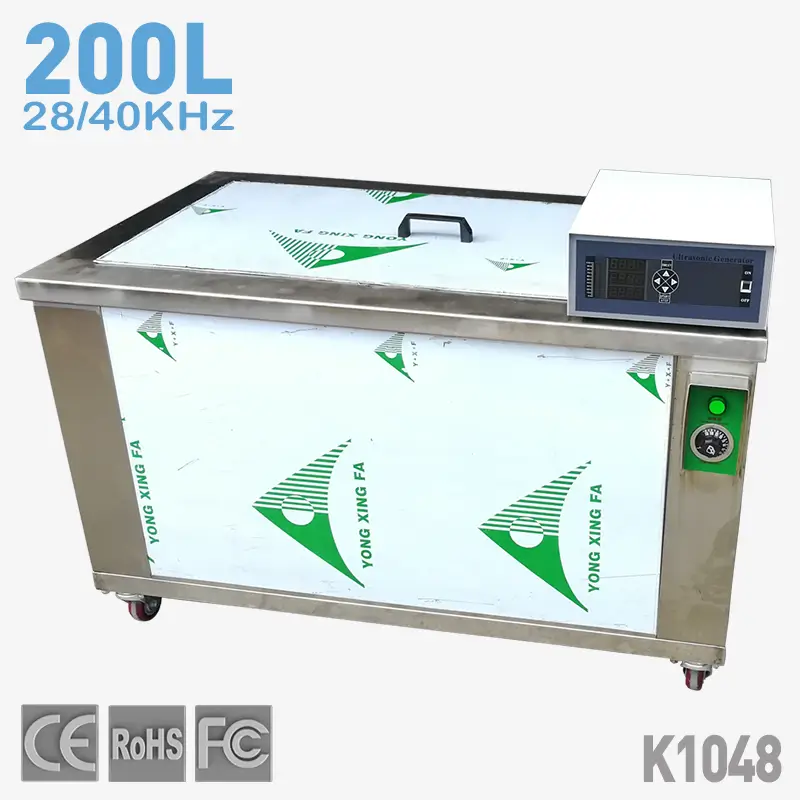
K Series Specifications Sheet
More K series industrial ultrasonic cleaning machines, ranging from 60 liters to 6000 liters, are available for your choice. Check whether the internal tank size is available for your cleaning items.

More Available Volumes




About Anonkia — the Ultrasonic Cleaner Manufacturer Behind the K1030
Anonkia is an ultrasonic cleaner manufacturer supplying industrial parts washers, ultrasonic degreasers, and benchtop baths to workshops, rebuilders, and manufacturers. [Anonkia has built cleaning equipment since 2013.] Every K-series industrial ultrasonic cleaner is built to order around a SUS304 tank and a separate generator, and each machine’s tank dimensions, working-bath volume, and heater rating are confirmed against the factory specification sheet before dispatch.
This page is maintained by the factory engineering team and updated when specifications or options change. [CE, RoHS and FC certification documents are available on request.] If a figure here differs from what your local supply or electrical code requires, send the part dimensions and supply details, and we will confirm the build before you order.
FAQ
Will a small-block V8 cylinder head fit in a 100L ultrasonic cleaner?
Yes, with care. The basket is about 576 × 426 mm internally, so a 550 mm head sits with roughly 13 mm at each end. Heads vary: a nominal small-block casting can measure anything from 508 to 560 mm depending on make and generation, so measure yours before ordering. Anything over 580 mm needs the 150L — but note that the 150L is also 600 mm long, so past roughly 580 mm you are really looking at the 200L.
How many cylinder heads can I clean per cycle?
One. Two heads side by side need about 1,100 mm of length, so the 500L at 1,200 mm is the first model that takes them in one load — the 300L at 1,000 mm will not. For volume head work, the 500L with a hoist, or back-to-back cycles on this machine, are both more realistic than forcing two into a 600 mm tank.
Should I choose 28 kHz or 40 kHz frequency?
28 kHz for cast iron, steel, carbon films and heavy grease; 40 kHz for aluminium, plated parts, precision machined surfaces and mixed loads. If you need both, ask about the dual-frequency version rather than compromising.
Will it remove rust, paint or scale?
No. Cavitation removes soil — oil, grease, carbon film, cutting fluid, polishing compound, handling dirt. Rust and scale are metal and oxide; a chelating detergent in a hot ultrasonic bath will loosen light surface rust over long cycles, but it is not a derusting machine. Heavy rust needs mechanical or acid treatment first, and we will tell you so rather than sell you a tank that will disappoint you.
Can the industrial ultrasonic cleaner run all day continuously?
The generator, transducers, and heater are built for production use, and the timer can be set to run continuously. What limits a day is the bath, not the electronics: oil loading, detergent depletion, and evaporation. Skim the oil, top up with water, and change the bath when it stops cleaning rather than on a fixed calendar.
What detergent should I use in an ultrasonic parts washer?
An aqueous alkaline degreaser at 3–5%, run at 55–65 °C for grease and carbon. Avoid chlorinated solvents and avoid acids on aluminium. Dose on 94.5 litres of working bath, not on the 100-litre model number.
Can I get a custom ultrasonic tank size?
Yes. Ultrasonic tanks on this platform are built to order, and custom builds have gone up to 6000 litres. But if your parts need more depth, or more than 580 mm of length, a bigger standard model is usually cheaper and faster than a custom 100 — send the part dimensions and we will say which way is worth doing.
Related products
-

200L Industrial Ultrasonic Washing Machine | Large Ultrasonic Parts Washer with Sweep Frequency
K1048 200L industrial ultrasonic parts washing machine with 2400W power and 6000W heating. Large parts washer with automatic sweep frequency…
-
240L Supersonic Ultrasonic Cleaning Machine for Industrial Use | Heavy Duty Parts & Machinery Cleaning
K1060 240L supersonic ultrasonic cleaning machine with 3000W power and 9000W heating. Built for heavy-duty industrial parts and machinery cleaning. …
-
800L Extra Large Industrial Ultrasonic Cleaner for Long Metal Parts and Assemblies
K1180 800L extra-large ultrasonic cleaner, 1500 x 800 x 680 mm ultrasonic tank for long metal parts and bellows. 9000W…
-
3110L Ultrasonic Cleaning Tank with Filtration | Immersible Transducer System for Marine Engine Parts
KF1576 3110L custom giant ultrasonic cleaning tank with an immersible transducer system, extra-large ultrasonic cleaning system with filtration for marine…



Any questions refer to this item? Just let us know!
Reviews
There are no reviews yet.