


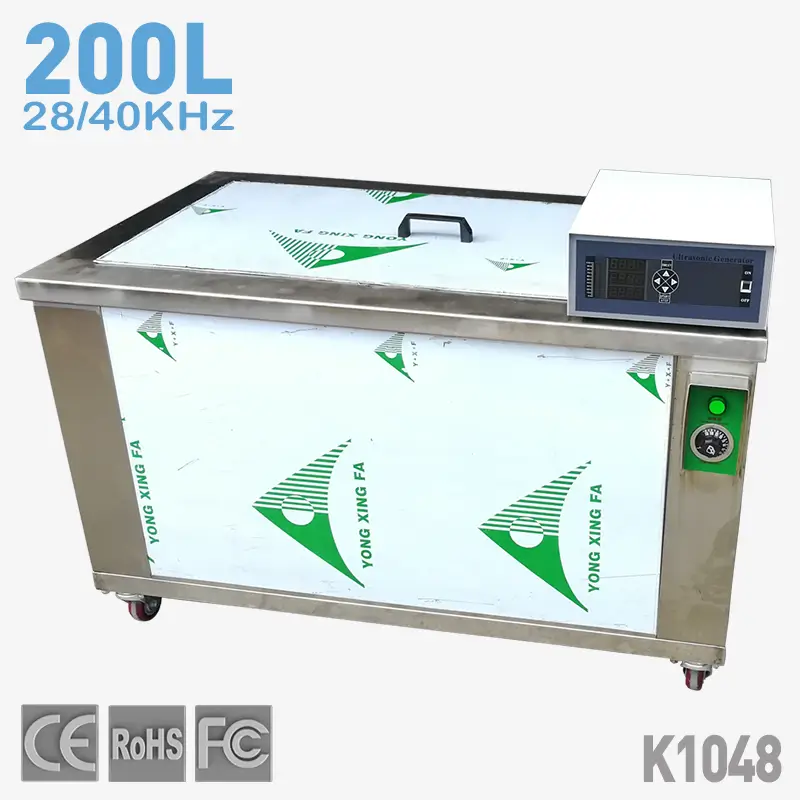
200L Industrial Ultrasonic Washing Machine | Large Ultrasonic Parts Washer with Sweep Frequency
K1048 200L industrial ultrasonic parts washing machine with 2400W power and 6000W heating. Large parts washer with automatic sweep frequency for uniform cleaning.
- Volume: 200 Litres
- Ultrasonic Power: 2400W (5-100% Variable Power)
- Input Voltage: AC 220-240V, 50Hz (AC 110-120V, 60Hz to order)
- Heating Power: 6000W (AC380-400V, 3-phase)
- Frequency: 28KHz or 40KHz (Optional)
- Internal Tank Size: 800 x 500 x 500 mm (Stainless Steel Tank)
- Overall Size: 1020 x 720 x 720 mm
- Operating Mode: Digital Control with Timer+Heater
- Timer Settings: 1-9999 seconds or long-time running
- Temperature: 20-95℃ adjustable
- Accessories: Stainless steel cleaning basket, lid, valve, power cable
- Wooden Case Size: 112 x 83 x 92 mm
- Gross Weight: 140 kg
WhatsApp: +8618681595853
200L Industrial Ultrasonic Washing Machine: Overview
The K1048 is a 200L industrial ultrasonic washing machine built as a large ultrasonic parts washer for long engine parts. The tank is 800 × 500 × 500 mm in SUS304 — long enough for a straight-six cylinder head at 700 mm, where every smaller tank in the range stops short. With 2400W of adjustable ultrasonics, a 6000W three-phase heater, and a 776 mm working basket, it is the machine you buy when part length, not just part weight, decides the ultrasonic cleaning tank.
This large ultrasonic cleaner comes with an independent industrial ultrasonic generator. The ultrasonic power of this 200-liter parts washer is adjustable from 5% to 100% and features an automatic sweep frequency function. So, it is a wonderful industrial ultrasonic washing machine. If needed, it can be equipped with an auto lift and a filtration system. A custom industrial ultrasonic cleaner with auto lift and filtration will make cleaning work easy and efficient.
This is a two-supply machine. The ultrasonic generator runs on single-phase AC 220–240 V, 50 Hz (or AC 110–120 V, 60 Hz). The 6000 W heater runs on three-phase AC 380–400 V. Both must reach the machine. If your site has no three-phase supply, this is not a reason to rule the model out: heater ratings are built to order, and the only cost of a smaller heater is a longer heat-up. Tell us your voltage and breaker capacity, and we will match the heater to it.
Who Should Buy the 200L Ultrasonic Washing Machine?
Buy the 200L industrial ultrasonic washing machine when your parts are long or numerous — a straight-six cylinder head, a crankshaft, a gearbox housing, or a full basket of small castings per cycle. It is also the practical choice for shops that clean in volume: 180 litres of working bath is where bulk washing stops being a per-part cost.
Do not buy it for weight alone. A 200 kg engine block goes in the 500L at 1,200 mm, and the 240L carries more floor area than this tank. Buy the 200L for length and batch size.
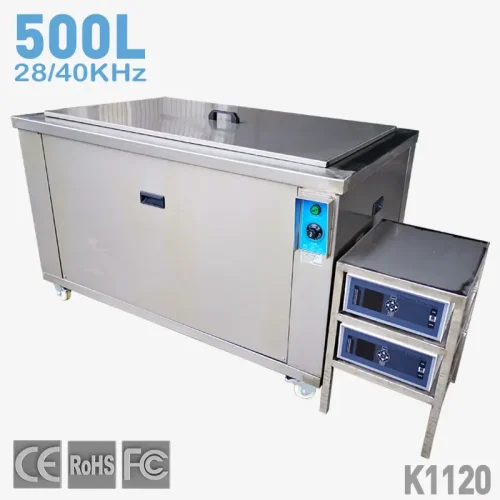
The three sizes worth comparing before you order: the 175L industrial ultrasonic degreasing machine is the same machine 100 mm shorter, the 300L large industrial ultrasonic cleaning tank at 1,000 mm takes a single longer part, and the 500L big ultrasonic cleaner at 1,200 mm is where two long components side by side — or a large engine block — fit.
How Big Is a 200 Litre Ultrasonic Cleaning Tank?
Every figure below is calculated from the tank, not from the model name.
| Measurement | Value | How it is derived |
|---|---|---|
| Tank to the rim | 200 L | 800 × 500 × 500 mm |
| Working bath | ≈180 L | 800 × 500 × 450 mm — filled 50 mm below the rim |
| Internal basket | ≈776 × 476 mm | allowing 12 mm each side for the basket wall |
| Working depth above the basket | ≈400 mm | 450 mm of water less the basket sitting height |
200 Litres to the Rim, 180 Litres at Working Level
Dose detergent on 180 litres, not on 200. At 5% by volume, that is about 9 kg of powder per fresh fill. Getting it 6% wrong is not a rounding error: an over-strength bath leaves a visible haze on machined faces, an under-strength one stops lifting carbonised oil and starts redistributing it instead of removing it.
The same 180 litres governs what a bath change costs and how long the next heat-up takes. Treat it as the real capacity and every other number on this page agrees with it.
The 800 mm Tank Length Is the Whole Argument
Tank length across the range runs 500 mm (60L), 550 mm (90L), 600 mm (100L, 120L, 150L), 700 mm (175L), 800 mm (this model), 1,000 mm (300L), 1,200 mm (500L). The 200L is the point where a 700 mm part fits with margin — a straight-six head, a full-length crankshaft, a gearbox case, a hydraulic cylinder body — and the parts that do not fit are genuinely bigger machines, not the next size up.
What Fits in a 200L Ultrasonic Parts Washer
This is the section most suppliers leave out, so the boundary comes first.
Inline-Six Heads and Long Crankshafts
A straight-six cylinder head runs to about 700 mm, and a crankshaft is longer again in many engines. In a 776 mm basket, a 700 mm head sits with roughly 38 mm at each end — enough to load without tilting the casting.
This is the boundary that makes the 200L worth buying. The 150L has a 600 mm tank and the 175L a 700 mm one, so neither takes a straight-six head with clearance. Above this model, the 300L at 1,000 mm takes a single longer part (to about 950 mm), and the 500L at 1,200 mm takes two long components side by side or a large engine block.
Gearbox Housings, Valve Bodies and Bulk Castings in the 200L Basket
The other half of the 200L’s workload is volume rather than length. Transmission and gearbox housings, valve bodies, hydraulic manifolds and pump housings sit comfortably within 776 × 476 mm, several at a time.
A basket of small machined castings is where the floor area pays for itself: 800 × 500 mm holds a full layer with 20–30 mm between parts, which is the spacing cavitation needs to reach the faces that matter.
What Does Not Fit in a 200L Ultrasonic Parts Washer?
Four loads defeat this machine, and it is cheaper to know now:
- A large engine block — a 1,200 mm tank is the requirement; see the 500L
- Two long components side by side — needs about 1,100 mm; the 300L (1,000 mm) is still short; the 500L takes it
- Parts over about 750 mm — the 300L (1,000 mm)
- Very heavy assemblies over roughly 150 kg — plan the hoist, or step to a model with a lift platform
Long Engine Parts in a 200L Tank: Where the 800 mm Matters
A cylinder head cleaned at the wrong orientation does not come clean, and the 200L is the tank where the customer stops compromising on orientation.
A straight-six head on its side presents one face upward and traps air in the passages. Standing on its end, with 400 mm of working depth and 500 mm of tank width, the deck face, the coolant jacket and the valve seats all sit under the bath at once. The oil galleries drain as they clean instead of holding the air bubble that no amount of extra minutes will shift.
The geometry does the work. This is why the 200L is worth the money over the 150L for the same head: not more power, but a tank the part fits into properly.
For shops that clean long components daily — crankshafts, camshafts, connecting rods in quantity, gearbox shafts — the same argument applies lengthwise. A 776 mm basket takes a 700 mm shaft in one pass. The 300L and 500L machines exist for the workloads where that is not enough; the 200L is the one that covers the widest range of long parts in the standard range.
How Ultrasonic Cavitation Cleans Long Engine Parts
Ultrasonic cleaning does not scrub. The generator drives transducers bonded to the underside of the ultrasonic tank, and the tank floor vibrates at 28 or 40 kHz. That pressure wave tears the water apart into millions of microscopic bubbles which collapse against the part surface. Each collapse produces a local jet that lifts soil out of geometry a brush cannot reach: valve guide bores, blind holes, oil galleries, the serrations on a shaft, the gap between a valve and its seat.
On a long part, the surface area to clean is large, but the contact area a brush can reach is small — a 700 mm crankshaft has journals, oil ways and threads running its whole length. That gap between what you can wipe and what actually has to come off is exactly where cavitation earns its place.
Ultrasonic Transducers and 13.3 W per Litre Power Density
At 2400 W across a 180-litre working bath, this machine delivers 13.3 W per litre. That is mid-range for the K series, and we will state it plainly: the 100L delivers 15.9 W/L and the 60L 17.3 W/L, while the 300L and 500L both sit at 12.0 W/L.
What that means in practice is that the 200L is built for volume and part size, not for maximum agitation force. Large castings and long assemblies need the litres to submerge them, and 13.3 W/L still lifts carbon and oil from deck faces within a normal cycle. If you are cleaning small, delicate components where force matters more than size, a 90L or 100L is the better tool.
Sweep Frequency Across an 800 mm Tank
Automatic sweep frequency band-shifts the drive continuously, which stops standing waves forming at fixed points. On an 800 mm tank this matters more than on a small one: with a long basket running most of the floor length, a fixed-frequency field would leave a long component cleaning strongly at one end and weakly at the other.
Sweep is what keeps a 700 mm shaft seeing the same energy from tip to journal. On this model, it is standard, not an option.
28 kHz vs 40 kHz: Ultrasonic Frequency for Long Parts
Both frequencies are available, and the choice follows the soil and the part, not the tank size.
28 kHz for Cast Iron, Carbon, and Heavy Oil
Longer wavelength, larger bubbles, more aggressive collapse. This is the setting for cast iron blocks and heads, carbon deposits, hardened grease, and parts that have sat. It penetrates deeper into rough surfaces and tolerates a bath that has been working for weeks.
40 kHz for Aluminium, Plated and Precision Machined Faces
Shorter wavelength, smaller bubbles, more even and gentler action. Use it for aluminium cylinder heads, machined deck faces, pistons, and any part where a matte or pitted surface would be a reject.
When Dual Frequency Is the Better Answer for Engine Parts
Many automotive shops run a dirty load first and a finishing pass second: 28 kHz to break the carbon, then 40 kHz to clean up the machined surfaces without dulling them. If that is your pattern, specify the dual-frequency option at order rather than compromising on one frequency all day.
Batch Throughput: How Many Parts Per Cycle
Batch size is the second reason to buy this size, and the one that pays back in labour rather than in fit.
On a basket of small machined castings, the 800 × 500 mm floor holds a full layer with the 20–30 mm spacing that cavitation needs. On long components, the 776 mm basket takes a 700 mm shaft in one pass. Either way, the number of parts handled per cycle is what determines how many hours a week the machine is occupied — and that, not the tank’s litre figure, is what a production line actually costs.
The 200L is the size where bulk washing stops being a per-part expense. Below it, you are washing a handful at a time; above it, you are buying a machine for the next workload up.
Ultrasonic Degreaser, Bath Temperature and Bath Life for Engine Work
Bath chemistry for engine work is not the same as general metal cleaning. Heavy crude oil from sumps and galleries, plus the aluminium fines that come off a freshly machined head, need a stronger alkaline with a clarifier, and a temperature that keeps it moving.
Dose at 5% by volume on 180 litres, hold at 50–60 °C for engine work, and keep the bath below the point where the alkaline attacks aluminium parts in the same load. Anodised or plated components are the exception — run those cold or in a separate cycle.
A used bath goes cloudy and foams before it stops working. On a 180-litre tank, change-out is a real production-line cost, so treat clarity as the signal rather than the calendar: a bath that still looks brown and clear may run for weeks, and one that has turned opaque grey has stopped lifting.
What Not to Put in an Ultrasonic Cleaning Bath
Avoid any solution containing chloride — it pits stainless steel over time, and a pitted tank will never return to a presentable finish. Parts with trapped coolant, and any assembly with a sealed bearing or an electronic module, need a separate ultrasonic pass or exclusion from the bath.
Ultrasonic Cleaning Cycle Times for Long Engine Parts
Cycle time on this machine is set by the load and the soil, not by the tank.
For a degreased head with light carbon, 25–35 minutes at 55–60 °C is typical. For a full teardown with hardened deposits and casting sand, allow 45–60 minutes and expect to run at 28 kHz for most of it. Keep the temperature high enough that the bath stays active, but not so high that you flash off the degreaser you are paying for.
Between loads, the 6000 W heater is what keeps the machine off the critical path: it recovers temperature faster than the smaller models, so a heavy casting dropped into a hot bath does not stall the queue.
Heat-Up Time for a 200L Ultrasonic Washing Machine
Heat-up is the number buyers ask about after tank size, so here are the actual figures rather than a marketing claim.
For 180 litres from 20 °C to 60 °C, the theoretical figure is about 84 minutes at 6000 W. Allow 95–100 minutes in practice for heat loss through the cabinet and the parts being loaded.
That is slower than the 150L, which needs about 63 minutes for a smaller 135-litre bath — the same heater, 45 litres more water. On a two-shift schedule, start the machine early or specify a larger heater for your supply.
Power Supply: Three-Phase Heater, Single-Phase Generator
Total connected load is 8,400 W: 2400 W of ultrasound on single-phase, 6000 W of heating on three-phase. As standard, that is roughly 8.7 A on the three-phase supply and 10.4 A on the single-phase supply at 400 V / 230 V respectively.
A smaller circuit can still be worked with — heater ratings are specified to suit the supply, and the only cost is a longer heat-up, which scales roughly in proportion. Report your voltage and breaker capacity, and we will quote the machine to fit it.
SUS304 Ultrasonic Cleaning Tank, Basket and Drain Valve
The tank is fabricated from heavy-gauge SUS304 stainless steel, reinforced at the stress points and polished inside so particulate does not adhere and lodge in the cavitation field. The rim is flanged over the tank body so the seam sits outside the bath, which is where a failed weld would matter most.
The mesh basket is what makes long parts practical: at 776 × 476 mm it takes a 700 mm crankshaft in one pass, and it keeps parts submerged and off the tank floor where the transducers are bonded — a part lying directly on the floor damps the very surface doing the work. Working depth above the basket is about 400 mm.
The drain with a flow-control valve is what makes a 180-litre change-out practical: connect a hose, drain into a drum or floor drain, and rinse down without lifting anything.
What a 200L Ultrasonic Tank Costs to Run
Two costs scale with capacity and are worth pricing before you commit: detergent (about 9 kg of powder per fresh fill at 5%) and electricity (a full cold heat-up pulls 6000 W for well over an hour, and 8,400 W while running). On a two-shift schedule, that is worth comparing against subcontracting.
200L vs 175L vs 240L vs 300L: Which Tank Size to Buy
These four are often confused because they share a family look and a similar floor. The differences are length and volume, and they buy different jobs.
| 175L Industrial Ultrasonic Degreasing Machine | 200L (this page) | 240L Supersonic Ultrasonic Cleaning Machine | 300L Large Industrial Ultrasonic Cleaning Tank | |
|---|---|---|---|---|
| Tank | 700 × 500 × 500 | 800 × 500 × 500 | 800 × 600 × 500 | 1,000 × 600 × 500 |
| Working bath | 175 L | 180 L | 240 L | 300 L |
| Ultrasound | 2,100 W | 2,400 W | 3,000 W | 3,600 W |
| Heater | 6,000 W | 6,000 W | 9,000 W | 9,000 W |
| Straight-six head (700 mm) | No (676 mm basket) | Yes (776 mm basket) | Yes | Yes |
| Two long parts side by side | No | No | No | No (needs 1,200 mm) |
| Engine block | No | No | Borderline | No |
| Batch floor area | 350 cm² | 400 cm² | 480 cm² | 600 cm² |
Read the table this way: the 175L is the same machine, 100 mm shorter. The 240L is wider but the same length, and it costs 9 kW of heating instead of 6 kW. The 500L at 1,200 mm is the first model that takes two long components side by side — the 300L at 1,000 mm is still short for that, and a large engine block also goes to the 500L.
For two long components in one load, or an engine block, the 500L Big Ultrasonic Cleaner at 1,200 mm is the real step, not another 50 litres.
K1048 200L Large Ultrasonic Parts Washer Specifications
| Parameter | Specification |
|---|---|
| Model | K1048 |
| Volume | 200 Liters |
| Ultrasonic Power | 2400W (5-100% variable power) |
| Frequency | 28KHz or 40KHz |
| Heating Power | 6000W (AC380-400V, 3 Phases) |
| Internal Tank Size | 800 x 500 x 500 mm (SUS304 stainless steel) |
| Overall Size | 1020 x 720 x 720 mm |
| Timer Settings | 1-9999 seconds or as long as 24 hours running |
| Heater Setting | 20-95℃ adjustable |
| Sonic Input Voltage | AC220-240V, 50Hz |
| Accessories | Stainless steel cleaning basket; Drainage; Lid; Power lines |
| Features | 5-100% power-adjustable; Automatic sweep frequency function; |
More Large Industrial Ultrasonic Washing Machines Specifications & Parameters
K Series Specifications Sheet
More K series industrial ultrasonic washing machines, ranging from 60 liters to 3000 liters, are available for your choice. Check if the internal tank size is available for your cleaning items.

More Available Volumes




Custom Ultrasonic Tank Sizes up to 6000 Litres
The standard range runs from 60 litres to 3,110 litres, and custom tanks have been built up to 6,000 litres — a 5,400-litre machine has been delivered. If your part does not fit any standard length or footprint, we can build to your dimensions rather than pushing you up a size you do not need.
Full tank drawings for the whole range sit on the industrial ultrasonic cleaner range page.


FAQ
What size cylinder head fits in the 200L ultrasonic washing machine?
A straight-six head at about 700 mm fits with clearance in the 776 mm basket — this is the practical reason to buy the 200L rather than the 150L or 175L, neither of which takes it. A large engine block does not fit; that needs a 1,200 mm tank.
Can I clean two long parts in one load?
Not in this machine — two long components need about 1,100 mm of tank length. The 300L at 1,000 mm is still short, and the 500L at 1,200 mm is the first model in the range that takes them side by side.
Which ultrasonic frequency should I use?
28 kHz for cast iron, carbon, and hardened oil. 40 kHz for aluminium, plated parts and machined deck faces, where you want a gentler action that will not dull the finish. Many shops run 28 kHz to break down the carbon, then 40 kHz for the finishing pass — specify dual frequency at order if that is your pattern.
How many parts can I clean per cycle?
Either a full basket of small castings on the 800 × 500 mm floor, or one long component — a 700 mm crankshaft or cylinder head — per load. Throughput depends on basket size and soil, but batch size is where this size earns its cost back, in hours of machine time rather than litres of solution.
Is the SUS304 tank safe for alkaline degreasers?
Yes — 304 grade is chosen for exactly that, and it withstands prolonged exposure to heated alkaline solutions and approved solvents. Avoid chloride-containing solutions, which pit stainless steel over time, and follow local disposal rules for spent bath.
Related products
-

240L Supersonic Ultrasonic Cleaning Machine for Industrial Use | Heavy Duty Parts & Machinery Cleaning
K1060 240L supersonic ultrasonic cleaning machine with 3000W power and 9000W heating. Built for heavy-duty industrial parts and machinery cleaning. …
-
500L Big Ultrasonic Cleaner | Custom Large Industrial Degreasing Tank for Engine Blocks
500L big ultrasonic cleaner for engine blocks with a 1200 x 700 x 600 mm large industrial degreasing tank. 6000W…
-
90L Industrial Ultrasonic Parts Washer | Large Ultrasonic Bath for Surgical & Medical Instruments
K1024 90L industrial ultrasonic parts washer for surgical & medical instruments, SUS304 stainless steel large ultrasonic bath, 1200W ultrasound, 4000W…
-
100L Industrial Ultrasonic Cleaner | Heavy-Duty Parts Washer for Auto & Engine Components
K1030 100L industrial ultrasonic cleaner for cylinder heads, with 4000W heating. Heavy-duty parts washer built for auto parts and engine…



Any questions refer to this item? Just let us know!
Reviews
There are no reviews yet.