

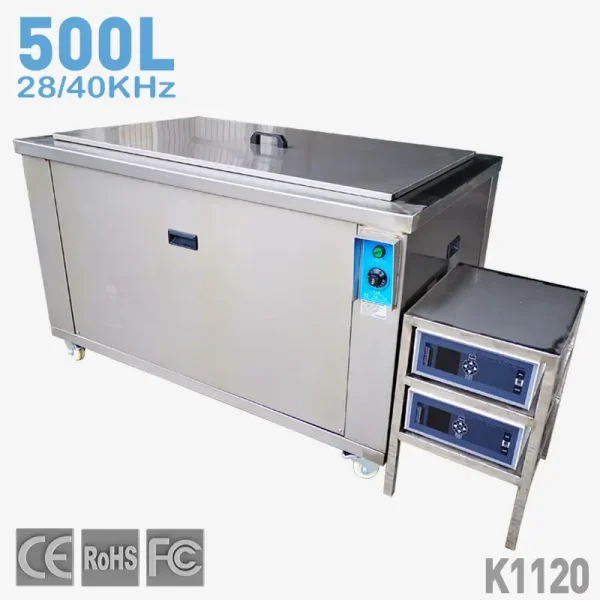




500L Big Ultrasonic Cleaner | Custom Large Industrial Degreasing Tank for Engine Blocks
500L big ultrasonic cleaner for engine blocks with a 1200 x 700 x 600 mm large industrial degreasing tank. 6000W ultrasound, 12000W 3-phase heat.
- Volume: 500 Litres
- Ultrasonic Power: 6000W (5- 100% variable power)
- Input Voltage: AC 220-240V, 50Hz (AC 110-120V, 60Hz to order)
- Heating Power: 12KW (AC380-400V,3phases)
- Frequency: 28KHz or 40KHz
- Internal Tank Size: 1200 x 700 x 600 mm (Stainless Steel Tank)
- Timer Settings: 1-9999 Seconds or long-time running
- Temperature: 20-95℃ adjustable
- Accessories: independent generator, cleaning basket, lid, power line
- Package Size: 155 x 102 x 104 cm
- Gross Weight: 250 KG
WhatsApp: +8618681595853
500L Big Ultrasonic Cleaner Overview
The K1120 is a 500L big ultrasonic cleaner built around one job above all others: cleaning complete engine blocks. A 6000W ultrasonic cleaning system drives cavitation through a 1200 × 700 × 600 mm degreasing tank, and a 12000W three-phase heater brings baked carbon and hard oil off those blocks rather than merely loosening it. At that internal length, a cylinder block or head goes in whole instead of being cut in half — which is what makes a 500 L large capacity ultrasonic cleaner worth the floor space it takes.
This is degreasing at production scale rather than a benchtop ultrasonic bath. The same principles apply — cavitation does the mechanical work, the detergent does the chemistry, and the temperature has to be right — but on a block-sized part, with a chemistry set for carbon rather than light oil, and on a machine built to run all shift.
The same capacity serves marine cylinder heads, gearbox housings, industrial moulds, large hydraulic bodies and aerospace fixtures, but if your parts are engine components, you are looking at the machine built for them. For large ultrasonic cleaners generally, the difference shows up after the part goes in: one load instead of three, fewer solution changes, and a cleaning cell that keeps pace with the line. That is what makes a 500 L tank the largest standard size that still fits a typical workshop floor — above it sit the 800 L (K1180) and the 3110 L (KF1576) extra-large industrial ultrasonic cleaner.
The tank is fabricated to order from 2.5 mm SUS304 — or 316L where chloride or acidic chemistry demands it — so length, width, and depth follow the work rather than the catalogue. Several independent generator cabinets sit apart from the tank, which keeps heat and vibration off the electronics and lets one cabinet be serviced without stopping the machine.
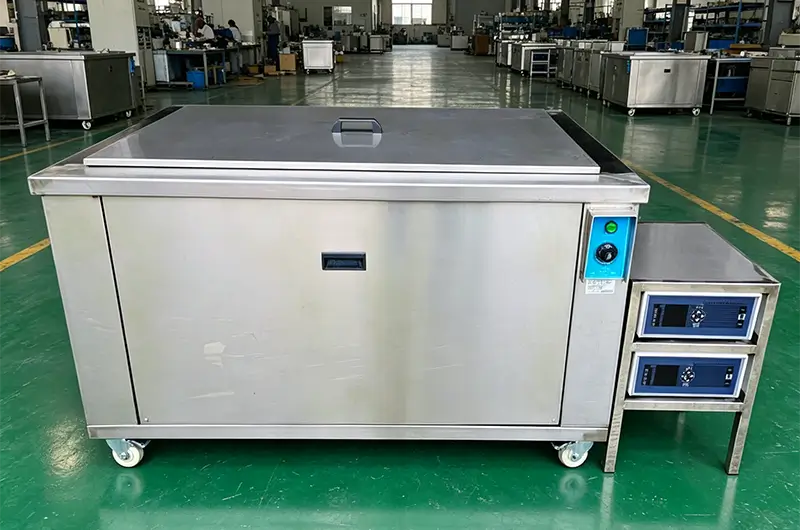
Table of Contents
Engine Block Cleaning: What This Tank Actually Does
An engine block is a hard cleaning problem for three reasons, and each one maps to something this machine does.
Carbon sits where a brush cannot reach. Combustion-chamber deposits, ring-groove lacquer, and gallery varnish build up in places no tool can physically enter. Cavitation forms and collapses microbubbles against those surfaces, stripping the deposit chemically and mechanically at once—including inside the oil galleries and the water jacket.
A block is too big for anything smaller. A typical automotive block runs 500–700 mm long; a marine or industrial engine block with head bolted on goes past 1200 mm. At 300 L you wash it in two or three loads; at 500 L it goes in whole. If your part is 1.3 m long, this tank will not take it, and no amount of ultrasonic power will change that — the 800 L (K1180) exists for exactly this case, and we will tell you so rather than sell you the wrong machine.
Aluminium and cast iron need different settings. Cast iron blocks tolerate aggressive 28 kHz cavitation without marking. Aluminium blocks and machined combustion decks do not — run those at 40 kHz and drop the power to the middle of the range. That is why the K1120 gives you 5–100% adjustable power rather than a fixed output: the same tank handles both.
Typical work at this capacity: engine blocks and cylinder heads, marine pistons and connecting rods, gearbox and transmission housings, turbocharger components, fuel injectors and diesel filter housings, hydraulic manifolds and valve bodies, extrusion and injection moulds. Where a shop previously sent parts out for degreasing, this 500L large ultrasonic cleaner brings the process in-house.
Ultrasonic Cleaner Tank Size and Dimensions
Litre ratings may mislead buyers. Two same-volume ultrasonic tanks sold as large-capacity ultrasonic cleaners can have completely different internal dimensions, and only one will fit an engine block. Shoppers comparing an ultrasonic cleaner big enough for a whole assembly should compare internal millimetres, not litre ratings — the K1120 ultrasonic tank size measures 1200 × 700 × 600 mm internally.
| Measurement | K1120 specification | What it means for you |
|---|---|---|
| Internal length | 1200 mm | The dimension that decides whether a whole engine block goes in flat or has to be split |
| Internal width | 700 mm | Room for a block with head attached, or two baskets of loose components side by side |
| Internal depth | 600 mm | Sets working depth — keep the load submerged with 50–60 mm of solution above it |
| Basket clearance | ~25 mm per side | The heavy mesh basket takes about 12 mm off each side |
| Working depth | ~540 mm at full fill | Basket floor to liquid line; your part must sit below it |
If your part exceeds 1200 mm in any direction, this tank will not take it, whatever the litre figure says. For engine blocks, that means the block goes in flat; a marine block with the head still bolted on usually does not, which is the most common reason a buyer moves from 500L to 800L. For large-scale ultrasonic cleaning where several shift-length batches run back to back, a large ultrasonic bath also pays off on solution consumption — one charge covers more loads. Give us your part dimensions, and we will match them against the standard shells — and if nothing fits, we will say so and quote a build instead.
Is This the Biggest Ultrasonic Cleaner You Can Buy?
Buyers searching for the biggest ultrasonic cleaner are usually working against a real constraint: a part that will not fit. Here is where this machine actually sits.
- Above 500L — the 800L (K1180) reaches 1500 mm internal length, and the 3110L (KF1576) goes further with an immersible transducer system.
- At 500L — this ultrasonic degreasing tank covers most engine blocks, marine cylinder heads, large moulds and hydraulic assemblies whole. It is the point where a full assembly stops needing to be sectioned.
- Below 500L — the 300L (K1072) handles bearing cages, injector bodies and single dies but forces a full block across two cycles.
There is no upper limit short of what we can fabricate. We have built custom industrial ultrasonic tanks on this platform up to 6000 litres.
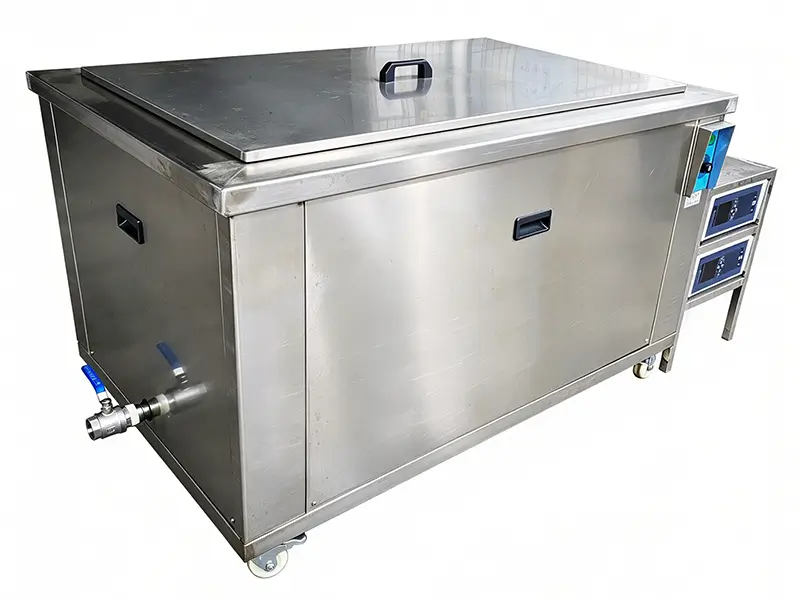
2.5mm SUS304 or 316L Tank, Built to Your Dimensions
This industrial degreasing tank is fabricated from 2.5 mm-thick stainless steel — SUS304 as standard, 316L where chloride or acidic chemistry demands it. Because the ultrasonic cleaning tank is made to order, the 1200 × 700 × 600 mm shell is a starting point, not a limit. A longer block or a deeper casting gets a tank cut to fit it, with the same generator and transducer layout underneath.
At 500 L, the filled tank weighs over half a tonne, so wall gauge decides structural life rather than any control feature. We also reinforce where the load concentrates, which is what lets the tank resist hydrostatic pressure and the thermal cycling of daily industrial use. This is the same reason an ultrasonic cleaner large enough to hold a marine cylinder head is built this way rather than from a thinner pressed shell.
Several Independent High-Power Ultrasonic Generators

Most large industrial ultrasonic cleaner designs run one generator. The K1120 runs several independent generator cabinets, each feeding its own transducer bank and sitting apart from the tank.
Three things follow from that. Output spreads evenly across a 1200 mm floor instead of concentrating in the middle. Heat, vapour and vibration stay away from the electronics, which is what allows continuous duty. And a cabinet can be isolated and serviced while the rest of the system keeps cleaning — on a rebuild line running blocks all shift, that is the difference between a planned service window and an unplanned stop.
Continuous 24-Hour Duty
Rated for uninterrupted operation beyond 24 hours, the K1120 500L big ultrasonic cleaner sustains cavitation without thermal trips. Heavy machinery maintenance that feeds parts all shift can keep the tank running, adding solution and lifting loads without a cool-down cycle. Overload and temperature protection are built in, and the controls are designed to keep sustained operation within the solution and generator limits.
6000W Variable-Power Ultrasonic Cleaning System
Output runs from 5% to 100%. Full power strips hardened carbon and baked lubricant from cast iron and steel; at the low end, delicate alloys and finished faces come out unmarked. Sweep frequency keeps the wave pattern moving, so the bath has no dead spots, and the whole 1200 mm bath cavitates evenly rather than in patches.
On a large-scale ultrasonic cleaning tank this size, that uniformity is what decides whether a part cleans the same at the far end of the bath as at the near end — which matters more as the load grows heavier and the soil harder.
Mesh Basket and Flow-Control Drain
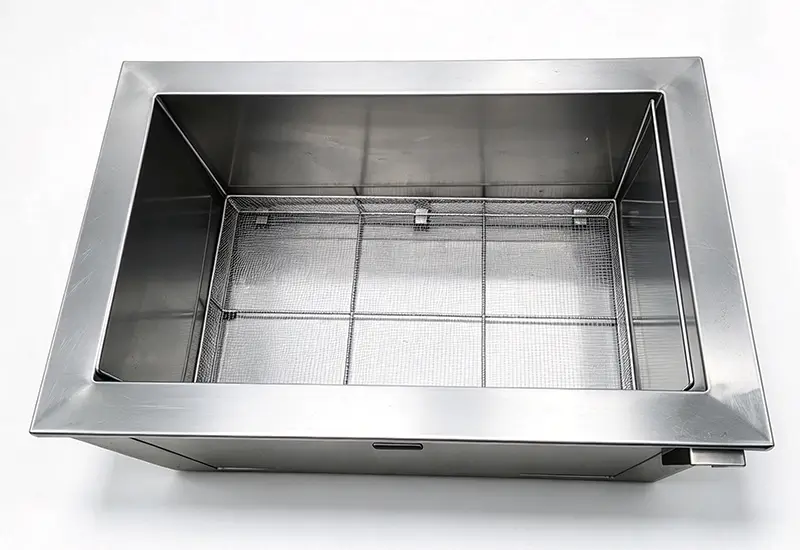
The heavy mesh basket keeps components off the tank floor so cavitation reaches every face, and it defines the working depth — which in turn sets the power density your parts actually see. Draining 500 litres of warm chemistry is a scheduled task rather than a messy one, because the drain valve is flow-controlled, so rinses and solution changes happen at whatever rate suits the line.
For an extra-large ultrasonic cleaner this size, add the recirculation and filtration option: solution circulates continuously and is filtered as contaminants lift off the parts, so one charge cleans more batches before a change-out. On a degreasing line running blocks back to back, that is the difference between a tank that keeps pace with the work and one that gets changed mid-shift.
Large Ultrasonic Cleaner Applications
The test for any large ultrasonic cleaner is simple: does your worst-case part go in whole? These are the jobs where a 500 L ultrasonic bath earns its footprint, with engine work first because that is what this size is built around.
Engine Blocks and Cylinder Heads — the Core Application
Rebuilders run engine blocks, cylinder heads, crankcases, pistons, and connecting rods through the K1120 ultrasonic degreasing tank. A complete block assembly sits submerged in one pass, removing carbon, ring-groove lacquer, and baked oil that spray washing leaves behind. This is the workload the 1200 mm internal length was sized for, and it is why engine work leads this list.
Frequency and power settings follow the material: 28 kHz at full output for cast iron, 40 kHz at reduced power for aluminium blocks and machined decks.
Marine Engines, Gearboxes and Aerospace Structures
Marine cylinder heads, pistons, gearbox and transmission housings, turbocharger components and fuel injectors all go in whole at this size, and aerospace fixtures sit comfortably inside the same envelope. Both sectors log and document their cleaning, so a repeatable clean that can be recorded for survey or inspection is worth more than a fast one.
Industrial Moulds and Tooling
Moulders pass extrusion and injection dies through the bath to strip polymer and release agent, and machine shops degrease large tooling and fixtures on the same cycle. Tooling that outgrew a smaller ultrasonic bath needs no re-rigging here.
Remanufacturing and General Parts Washing
Rebuild shops, general engineering firms, and plating lines all land on the same configuration here, because the constraint is identical: a part too big for a bench machine, and a soil load too heavy for spray washing. Send us your batch volume and contamination type, and we will size the filtration to match.
How to Specify a Custom Ultrasonic Tank
Specifying a custom ultrasonic cleaner comes down to four numbers. Send us your requirements, and we will size the machine, choose the material grade, set the frequency, and quote.
- Largest part — length × width × height, including any fixture it sits in. For engine work, measure the block with the head removed, and add the cylinder head as a second measurement if it runs long
- Quantity per batch — how many pieces, or whether it is a single assembly
- What you are removing — carbon and baked oil (engine), cutting oil, polishing compound, rust, scale, or a mix
- Daily throughput — batches per shift, and how many shifts you run
From those, we specify the ultrasonic tank dimensions, wall grade (SUS304 or 316L), transducer count and frequency, confirm the voltage, and quote. For aluminium engine blocks, we set 40 kHz and a reduced power ceiling; for cast iron at full output. Drawings are welcome — most custom tanks start from a part drawing rather than a model number.
Fitting the 500L Into Your Line
At 500 L, the K1120 large ultrasonic cleaner is the production workhorse for engine blocks, industrial moulds and large hydraulic bodies cleaned in one load. Size it against its neighbours:
- Down to 300 L (K1072) if most loads are bearing cages, injector bodies or single dies under 1000 mm — the smaller tank roughly halves the heater load and the solution volume per change-out
- Up to 800 L (K1180) when a marine cylinder head or shaft coupling exceeds 1200 mm — the 800 L’s 1500 mm tank submerges a complete head without sectioning
- Full internal dimensions for every volume are on the industrial ultrasonic parts cleaner series page
K1120 500L Big Ultrasonic Cleaner Specifications
| Parameter | Specification |
|---|---|
| Model | K1120 |
| Volume | 500 Liters |
| Ultrasonic Power | 6000W (5-100% variable power) |
| Frequency | 28KHz or 40KHz |
| Heating Power | 12000W (AC380-400V, 3-phase) |
| Internal Tank Size | 1200 x 700 x 600 mm |
| Overall Size | 1420 x 920 x 820 mm |
| Timer Settings | 1-9999 seconds or as long as 24 hours |
| Heater Setting | 20-95℃ adjustable |
| Sonic Input Voltage | AC220-240V, 50Hz |
| Accessories | Stainless steel cleaning basket; Drainage; Lid; Power lines |
| Features | 5-100% power-adjustable; Automatic sweep frequency function |
What’s Included
- K1120 500L ultrasonic cleaning tank with lid
- Independent ultrasonic generator cabinets
- Stainless steel mesh cleaning basket
- Drainage kit with flow-control valve
- Power lines
- Packed in a wooden case (gross weight 250 kg)
More Large Industrial Ultrasonic Cleaners Specifications & Parameters
K Series Specifications Sheet
More K series industrial ultrasonic cleaners, from 60 litres up to 3110 litres, are available for your choice — and custom large ultrasonic cleaning tanks on this platform have been built to 6000 litres. Check whether your part fits the internal tank size before you choose a volume.
| Model | Volume | Ultrasonic Power | Tank Size (mm) |
|---|---|---|---|
| K1072 | 300L | 3600W | 1000 × 600 × 500 |
| K1120 (this page) | 500L | 6000W | 1200 × 700 × 600 |
| K1180 | 800L | 9000W | 1500 × 800 × 680 |
More Available Volumes




FAQ
What is the largest part this tank can take?
The standard tank is 1200 × 700 × 600 mm internally, and it is built to order — give us your part dimensions, and we make the ultrasonic cleaning tank to fit, keeping clearance for the basket and the solution surface. If your part exceeds 1200 mm, the 800L and 3110L builds may suit you better; we will say so rather than sell you the wrong tank.
Is this the biggest ultrasonic cleaner available?
No, and we would rather tell you than oversell. Above this machine sit the 800L (K1180) at 1500 mm internal length and the 3110L (KF1576) with an immersible transducer system. Custom ultrasonic tanks on this platform have been built up to 6000 litres. What the 500L does is cover complete engine blocks, cylinder heads, large moulds and hydraulic assemblies in one load — which is where most buyers actually need to be.
Can it clean a complete engine block, and what settings does that need?
Yes — a block up to 1200 mm long goes in whole, which is what this capacity is for. Settings follow the material: cast iron blocks run at 28 kHz and full output, which handles combustion-chamber carbon, ring-groove lacquer, and gallery varnish. Aluminium blocks and machined combustion decks need 40 kHz with the power turned down to protect the surface. Give us the block material and the fouling, and we will confirm the setting before the build.
What solution should I use for engine carbon?
A two-stage approach works best: alkaline for the bulk carbon and baked oil, then a shorter stage for the ring grooves and passages if you are preparing the block for inspection. Run 60–70°C — the heater will reach 95°C, but cavitation loses efficiency well before that — pushing the temperature higher does not shorten the cycle. We can recommend specific chemistry once we know what you are cleaning.
How is the ultrasonic tank heated and powered?
The 12000W heater runs on three-phase AC 380–400V; the ultrasonic generators run on single-phase AC 220–240V, 50Hz (110–120V 60Hz to order). The heater is the only circuit that needs three-phase. 60–70°C covers oil and grease; the thermostat goes to 95°C if a process calls for it.
Can I get a custom ultrasonic cleaner size?
Yes. Every K1120 ultrasonic cleaner is built to order in SUS304 or 316L, with length, width, and depth set to your parts. For very large requirements, a drop-in immersible transducer configuration is often the better build — we will advise based on your dimensions and throughput. If you already know your largest part is beyond 1200 mm, tell us before quoting: we will compare the 800L against a custom build so you are not paying for a tank that still will not fit.
Can the machine run through a full production shift?
Yes. The machine is built for round-the-clock running, and the overload and temperature cut-outs are there to protect it. Keep the solution and the generators within their working limits, and it will hold that duty cycle shift after shift.
Related products
-

800L Extra Large Industrial Ultrasonic Cleaner for Long Metal Parts and Assemblies
K1180 800L extra-large ultrasonic cleaner, 1500 x 800 x 680 mm ultrasonic tank for long metal parts and bellows. 9000W…
-
Custom Ultrasonic Anilox Roller Cleaner for Ceramic and Stainless Steel Printing Rollers
Custom ultrasonic anilox roller cleaner for ceramic and stainless steel printing rollers, with rotating shaft design, adjustable roller position, and…
-
60L Industrial Ultrasonic Cleaner | Heated Sonicator Bath for Laboratory Instrument Trays and Glassware
K1018 60L industrial ultrasonic cleaner with 500 x 350 x 350 mm ultrasonic bath, heated sonicator bath for laboratory instrument…
-
240L Supersonic Ultrasonic Cleaning Machine for Industrial Use | Heavy Duty Parts & Machinery Cleaning
K1060 240L supersonic ultrasonic cleaning machine with 3000W power and 9000W heating. Built for heavy-duty industrial parts and machinery cleaning. …


Any questions refer to this item? Just let us know!
Reviews
There are no reviews yet.